Teeth Whitening is a cosmetic treatment with a single, focused purpose: to lift the accumulated colour out of natural enamel so that a smile looks fresher, cleaner and closer to the shade it once was. Everything described on this page exists to support that goal safely.
The services set out below cover the complete journey, from the first conversation about whether Teeth Whitening is appropriate, through the treatment session itself, and onward into the aftercare that decides how long the improvement lasts. Each stage matters. A well-conducted session with poor aftercare produces disappointing longevity, and excellent aftercare cannot rescue a treatment that was carried out on unsuitable teeth. The two halves work together, which is why they are presented here as one continuous service rather than as a procedure followed by a leaflet.
Many people arrive at Teeth Whitening after trying supermarket strips, charcoal powders, whitening toothpastes and online kits, and finding that the results were either invisible or uneven. That experience is common and it is worth understanding why it happens. Over-the-counter products are formulated for unsupervised use by anyone who buys them, which necessarily means low active concentrations and generic applicators. A one-size-fits-all tray cannot follow the contours of an individual set of teeth, so the active material pools in some areas and barely touches others. The outcome is patchy, and patchiness is more noticeable than the original staining was.
Just as importantly, a professional service is honest about limits. Teeth Whitening changes colour and nothing else. It does not straighten, reshape, close gaps, repair chips or alter the position of teeth. It has no effect whatsoever on crowns, veneers, bridges, dentures or composite fillings, all of which keep their existing shade permanently. Knowing this before treatment starts prevents the most common source of dissatisfaction, which is not a poor result but an expectation that was never achievable in the first place.
The pages that follow this one give further context. The results page explains what a realistic shade change looks like and how long it tends to hold. The prices page sets out how Teeth Whitening is costed and what a session includes. The choose us page covers standards, training and the reasoning behind the approach taken here.
The Teeth Whitening Service Explained
The core service is a single supervised Teeth Whitening session lasting approximately one hour, carried out in one appointment, producing a visible change in shade by the time the session ends. There is no course of repeat visits built into the standard treatment, no trays to take home and wear nightly for a fortnight, and no waiting period before the result becomes apparent.
That structure is deliberate. The alternative model, in which a tray and gel are dispensed for the client to use at home over two or three weeks, asks a great deal of the person using it. It requires them to remember daily application, to load the tray with the correct quantity of gel, to seat it accurately, to wear it for the right duration, and to persist for long enough to see a difference. In practice, compliance drops off. People forget, or find the trays uncomfortable, or over-fill them and irritate their gums, or simply lose momentum after the first week. A single supervised session removes all of those variables.
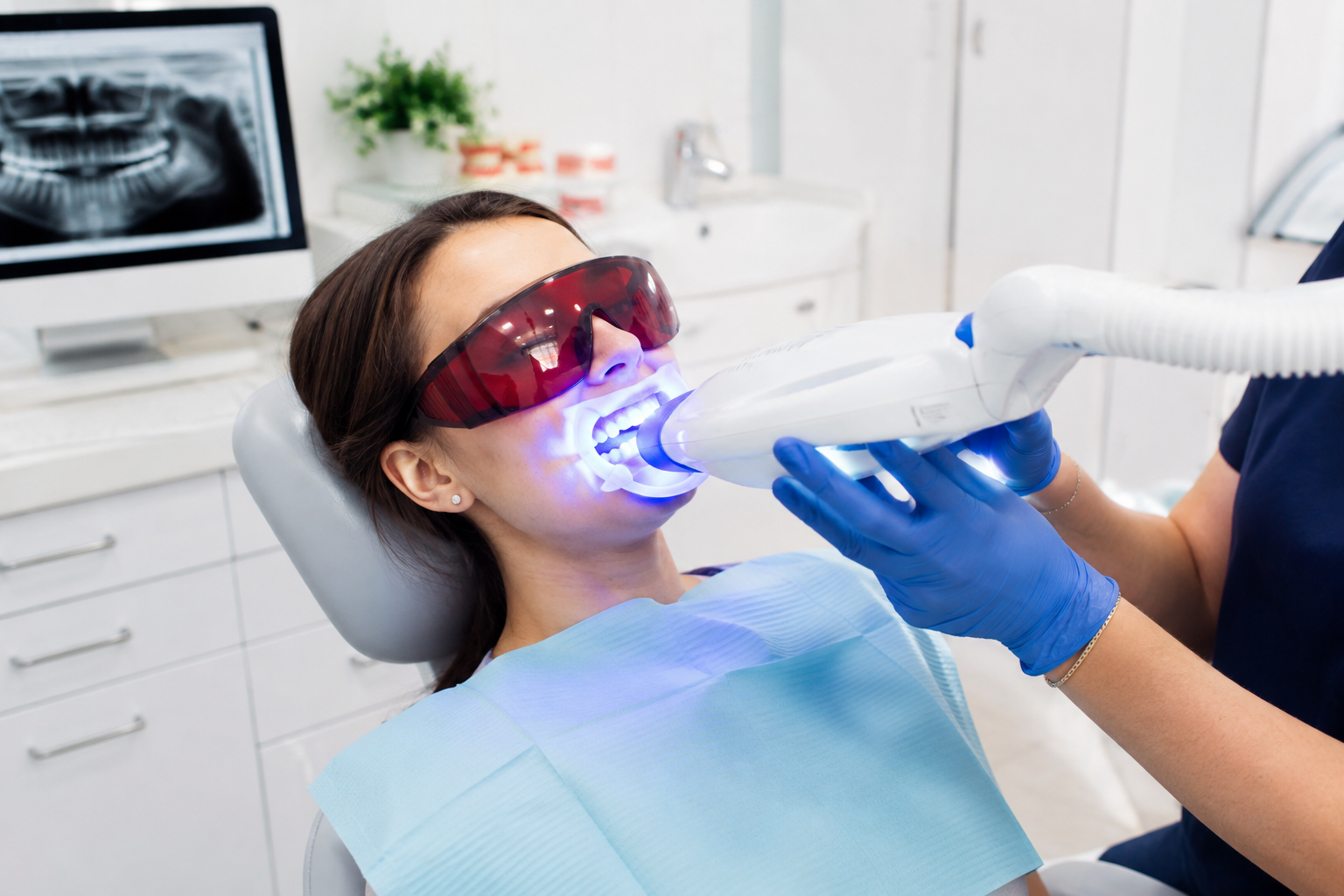
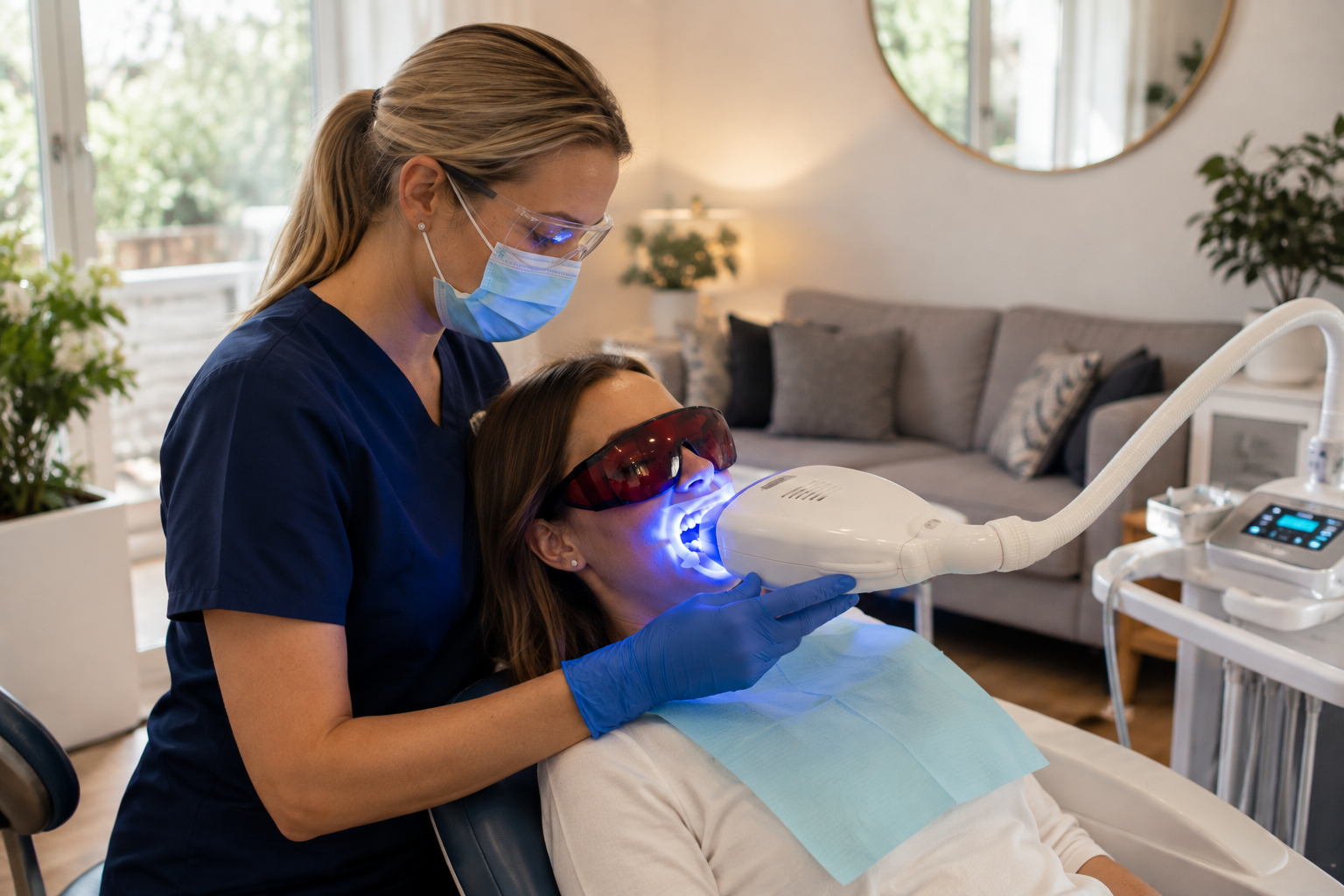
During the session, the whitening material is applied directly to the front surfaces of the visible teeth and activated. Activation is what distinguishes a professional session from passive application: rather than leaving a gel to work slowly over hours, the process is accelerated so that the same chemical work happens within a controlled window. The teeth are typically treated across several sequential applications within the hour, with the material refreshed between each one so that its effect stays consistent from the first application to the last.
Between applications, the shade is checked. This is not a formality. Teeth do not lighten at a uniform rate, and the point at which further applications stop producing meaningful change varies from person to person. Checking progress means the session can be tailored, extended slightly, or concluded early if the teeth have already reached the point where additional applications would add nothing.
What is included in a standard session
- A pre-treatment discussion covering dental history, previous whitening attempts and any sensitivity concerns
- A visual assessment of the teeth and gums to confirm that treatment is appropriate on the day
- A recorded starting shade, so the change is measurable rather than a matter of impression
- Isolation and protection of the lips, gums and surrounding soft tissue
- Multiple sequential applications of the whitening material across the session
- Shade monitoring throughout, with the session adjusted according to how the teeth respond
- A closing shade comparison against the recorded starting point
- Full verbal and written aftercare guidance, including the white diet protocol
- Follow-up availability for questions in the days afterwards
Nothing in that list is an optional extra. The assessment is not a separate paid consultation, the shade recording is not an add-on, and the aftercare guidance is not sold as a package. They are components of a single service because omitting any one of them degrades the result.
Your Consultation and Suitability Assessment
Every Teeth Whitening appointment opens with a conversation and an assessment before any material is prepared. This stage is short, usually ten to fifteen minutes, but it determines whether the rest of the appointment goes ahead as planned.
The purpose is to answer three questions. Are the teeth and gums in a condition where Teeth Whitening is appropriate today? What kind of discolouration is present, and is it the kind that responds? And what does this particular person actually want the outcome to be?
Condition of the teeth and gums
Teeth Whitening should be carried out on healthy teeth and healthy gums. Where there are signs of untreated decay, active gum inflammation, exposed root surfaces, cracked enamel or a broken restoration, treatment is postponed and a dental appointment is recommended first. This is not caution for its own sake. Whitening material on an exposed dentine surface or against inflamed gum tissue causes far more discomfort than it would on intact enamel, and it can mask a problem that needs attention rather than concealment.
Postponement is genuinely a postponement, not a refusal. Once the underlying issue has been treated by a dentist, Teeth Whitening can usually go ahead normally.
Type of discolouration
Not all staining behaves the same way, and being clear about which type is present is the single best predictor of how satisfying the result will be.
Extrinsic staining
Colour that has accumulated on and just beneath the outer enamel surface from tea, coffee, red wine, cola, curry, soy sauce, dark berries and tobacco. This is the most common form of discolouration and the type that responds most predictably to Teeth Whitening.
Age-related darkening
Enamel thins gradually across a lifetime while the dentine beneath it naturally deepens in tone. The combined effect is a warmer, duller appearance. Teeth Whitening usually improves this noticeably, though the underlying thinning is not reversed.
Intrinsic staining
Colour originating within the tooth structure, from certain medications taken during tooth development, from developmental enamel conditions, or from trauma to an individual tooth. Response is far less predictable and may be partial or negligible.
Restorations
Crowns, veneers, bridges, dentures and composite fillings do not change colour at all. If they sit in the visible smile line, the shade difference between them and the surrounding natural teeth will become more pronounced after treatment.
What you want from the treatment
Expectations vary widely and it is worth stating them out loud. Some people want a subtle refresh that nobody comments on directly. Others have a specific event in mind and want the most noticeable change achievable in one session. Some arrive with a photograph and a shade in mind that is not attainable on their enamel. An honest conversation at this point, before anything is applied, is far kinder than a disappointed conversation an hour later.
The One-Hour Teeth Whitening Session, Step by Step
Knowing what will happen removes most of the apprehension people bring to a first Teeth Whitening appointment. The session follows the same sequence every time, and there are no surprises built into it.
Step one: settling and preparation
You are seated comfortably in a reclined position. Nothing sharp is used, no injections are involved, and no drilling of any kind takes place. If you have chosen a home-based appointment, this happens in your own front room, on your own sofa or a comfortable chair, with equipment brought to you and set up in a few minutes.
Step two: shade recording
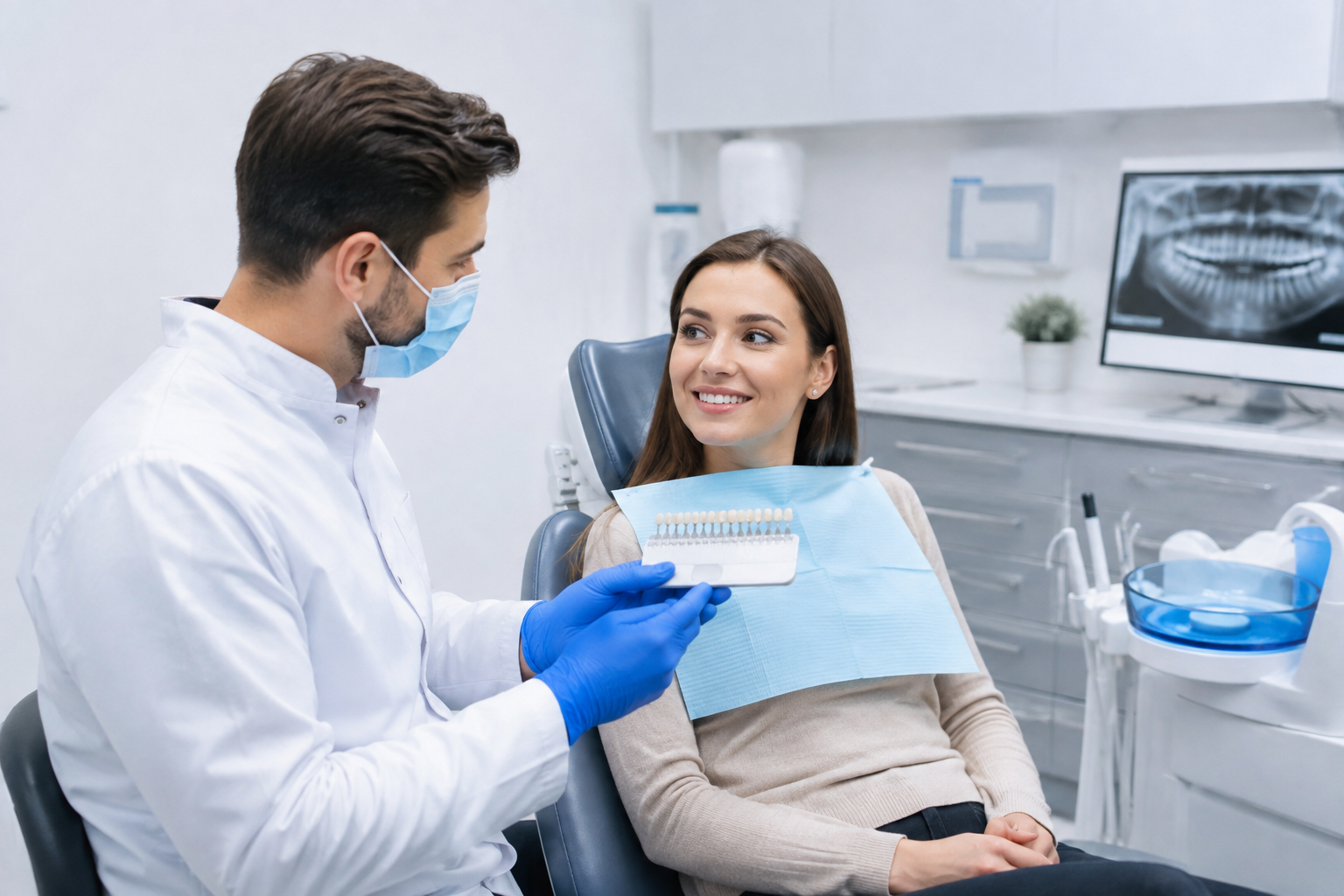
A shade guide is held against your teeth in natural or neutral light and the closest match to your current colour is recorded. Photographs may be taken at this point with your permission. This step takes a minute and provides the reference against which the final result is judged. Without it, both parties are left comparing an hour-old memory with a present reality, and memory is unreliable about colour.
Step three: isolation and protection
The lips and cheeks are gently retracted so that the front teeth are fully exposed and no soft tissue rests against them. A protective barrier is applied along the gum line where it meets the teeth. This barrier is the single most important safety step in the whole session, because it keeps the whitening material confined to enamel where it belongs. Applying it carefully takes a few minutes and it is not a stage worth hurrying.
Step four: first application and activation
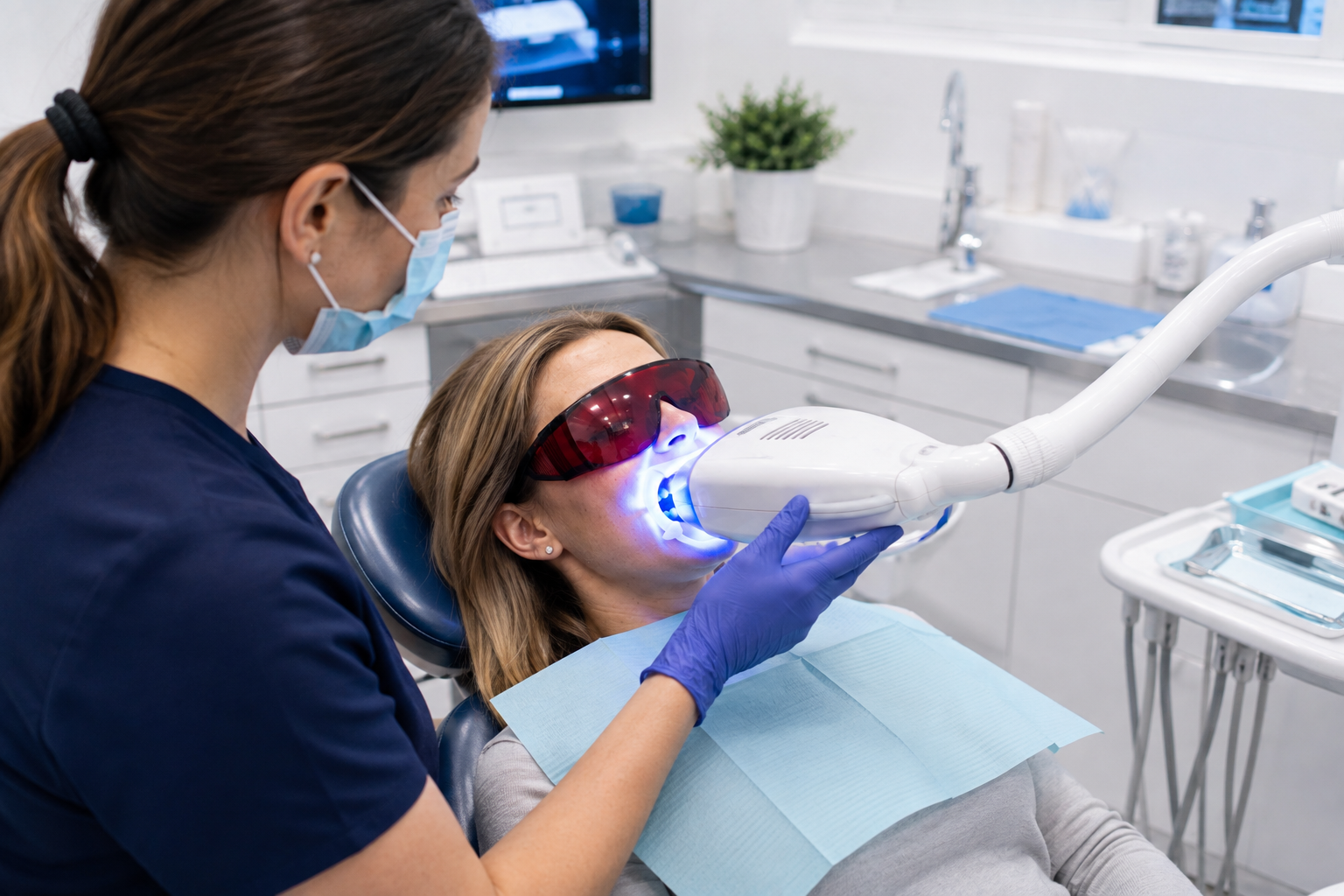
The whitening material is applied evenly across the front surfaces of the visible teeth, usually from second premolar to second premolar on both arches, which covers everything that shows in a normal smile. The activation light is positioned and the first cycle begins. During this period you simply rest. Most people listen to something, watch something, or close their eyes. You are not required to hold anything or do anything.
Step five: repeat cycles with shade checks
At the end of each cycle the material is removed and replaced with fresh material, and the shade is checked. A typical session runs three cycles, though this varies. Between cycles is the natural moment to mention anything you are feeling. If a particular tooth feels more reactive than the others, saying so allows the approach to be adapted for the remaining cycles rather than pressing on regardless.
Step six: final removal, comparison and aftercare
The material and the protective barrier are removed completely, your mouth is rinsed, and the shade guide comes out again. The starting shade and the finishing shade are compared side by side. This is the moment most people remember, partly because the change is more obvious against a reference than it is in a mirror. You are then talked through the aftercare protocol in detail, and given it in writing, because the next forty-eight hours matter considerably.
Home-Based Teeth Whitening Appointments
Teeth Whitening does not require a clinical environment to be carried out properly. It requires trained hands, correct materials, adequate light and a person who can sit still for an hour. A home appointment supplies all four, and for a great many people it removes the last practical obstacle to having the treatment at all. For clients considering professional whitening locally, Ultimawhite Lisburn provides another option for accessing a dedicated Teeth Whitening service.
The appeal is straightforward. No travel time in either direction, no parking, no waiting room, no half-day booked off work, and no need to arrange childcare simply to attend an appointment. For anyone with mobility difficulties, anxiety about clinical settings, an unpredictable work pattern or small children at home, the difference between a treatment that has to be travelled to and one that comes to them is often the difference between having it and not.
What is needed at your end
- A comfortable chair or sofa where you can recline slightly for about an hour
- Reasonable light, though additional light is brought as standard
- Access to a power socket within reach of the seating
- Access to a sink or bathroom for rinsing
- An hour and a quarter of relatively undisturbed time
That is genuinely the full list. There is no need to prepare the room, clear furniture or provide anything else. Everything required for the treatment is brought, set up and taken away afterwards.
Appointments for two people
Booking two people into the same visit is common and works well. Couples do it before a wedding or an anniversary, friends do it before a holiday, and family members do it simply because it is more convenient than arranging two separate appointments. The two treatments are carried out sequentially rather than simultaneously, since each person receives the same individual assessment, protection and monitoring. The visit is longer overall but considerably shorter than two separate visits would be, and the arrangement is reflected in how the appointment is costed, which is covered on the prices page.
Standards do not change at your front door
A home appointment is not an informal version of the treatment. The same assessment is carried out, the same protective barrier is applied, the same materials are used, the same shade recording happens, the same hygiene procedures are followed, and the same aftercare guidance is given. Equipment is cleaned between clients, single-use items are used once and disposed of, and nothing is reused between people. The setting is more comfortable; the standard is identical.
Choosing a professional Teeth Whitening provider is about more than the treatment itself. Training, hygiene standards, equipment, consultation procedures and the way clients are supported all contribute to the overall experience. You can learn more about the approach and standards behind the service on the https://watford.ultimawhite.co.uk/choose-us/ page
A Gentle, Peroxide-Free Approach
The whitening material used in these Teeth Whitening sessions is peroxide-free. That distinction matters to a specific group of people and it is worth explaining plainly rather than presenting it as a slogan.
Peroxide-based whitening agents are effective and are widely used. They also account for most of the discomfort associated with tooth whitening. The sharp, electrical sensations that people describe as zingers, the gum irritation that follows when material escapes the intended area, and the lingering cold sensitivity that can persist for a day or two afterwards are all far more strongly associated with peroxide chemistry than with the alternatives.
A peroxide-free formulation works more gently on the same problem. The trade-off is honest: on very heavily stained teeth, a strong peroxide system may achieve a slightly greater single-session shade change. What a peroxide-free approach offers instead is a considerably more comfortable experience, less soft-tissue reaction, and suitability for people who have previously abandoned whitening because they could not tolerate it.
Who benefits most from the gentler approach
- Anyone who has tried whitening before and found the sensitivity unbearable
- People with generally sensitive teeth who react to cold drinks or cold air
- People with some gum recession, where root surfaces are more exposed than usual
- Anyone who is nervous about dental treatment and wants the least intrusive option
- People who want a natural improvement rather than the most dramatic change possible
It is worth saying clearly that no whitening approach can promise zero sensitivity for every person. Individual variation in enamel thickness, dentine tubule structure, existing recession and general reactivity means that a small number of people will notice some sensation whatever material is used. What a gentler formulation reliably does is reduce both the likelihood and the severity, which for most people is the difference between an hour that passes uneventfully and an hour they endure.
Who Teeth Whitening Suits, and Who Should Wait
Teeth Whitening suits most adults with healthy teeth whose enamel has dulled, yellowed or picked up colour from years of ordinary living. That describes a very large proportion of the population. But it does not describe everyone, and being clear about the exceptions is part of providing the service responsibly.
Good candidates
- Adults with generally healthy teeth and gums
- People whose teeth have gradually yellowed or dulled with age
- Regular tea, coffee, cola or red wine drinkers with surface colour build-up
- Current or former smokers with tobacco staining on otherwise sound enamel
- Anyone preparing for a wedding, a significant birthday, a holiday, a job interview, a graduation or a photographed occasion
- People who have had whitening previously and want to refresh a shade that has drifted back
Situations where treatment should be postponed
- Pregnancy or breastfeeding, where the standard advice is to wait, not because harm is established but because cosmetic treatment is not worth undertaking without a reason to
- Untreated tooth decay, which should be dealt with by a dentist first
- Active gum disease or gums that bleed readily when brushed
- Significant enamel erosion, exposed dentine or extensive root exposure
- A cracked, chipped or loose restoration in the treatment area
- Recent oral surgery or an extraction site that has not fully healed
- Under-eighteens, for whom cosmetic whitening is not appropriate
- Anyone currently undergoing dental treatment that has not been completed
Where results are likely to be limited
Some people are suitable for treatment but should expect a smaller change. Deep intrinsic staining from tetracycline exposure during tooth development typically produces banded grey or brown discolouration that responds poorly. A single tooth that has darkened after trauma has usually changed colour from the inside and will not lighten in step with its neighbours. Naturally grey-toned enamel generally shifts less than naturally yellow-toned enamel, because yellow chromogens break down more readily. Fluorosis produces white mottling that whitening can make less obvious against a lightened background, but does not remove.
None of these rule treatment out. They change what a reasonable expectation looks like, and it is far better to know that beforehand.
Aftercare: The First Twenty-Four to Forty-Eight Hours
The aftercare window is the most important part of the entire Teeth Whitening service, and it is the part most often underestimated. What happens in the two days after a session has a larger effect on how long results last than almost anything else.
The reason is structural. Enamel is not a smooth, sealed shell. It is a dense mineral surface threaded with microscopic pores. During Teeth Whitening those pores open slightly, which is precisely what allows the whitening material to reach and break down the colour molecules held within them. Immediately after treatment, before the surface has fully rehydrated and resettled, those same pores remain temporarily more open than usual. For roughly forty-eight hours the enamel is unusually receptive to anything pigmented that touches it.
The simplest rule worth remembering
If it would stain a white cotton shirt, it will stain freshly whitened enamel. That single test covers almost every food and drink you will encounter, without needing to memorise a list. Apply it for forty-eight hours and the guidance below becomes largely intuitive.
Avoid completely for forty-eight hours
- Tea of every kind, including green tea and most herbal and fruit infusions
- Coffee, including decaffeinated coffee and milky coffee
- Red wine, and white wine, which is acidic even though it is pale
- Cola and other dark fizzy drinks
- Fruit juices, particularly blackcurrant, cranberry, grape and orange
- Curry, chilli, turmeric-based dishes and anything containing paprika
- Soy sauce, balsamic vinegar, brown sauce, ketchup and most dark marinades
- Tomato-based sauces and dishes
- Berries of all kinds, along with beetroot, cherries, plums and dark grapes
- Chocolate, coloured sweets, ice lollies and anything with strong food colouring
- Smoking, vaping and all tobacco use
- Coloured mouthwash, which is a frequently forgotten source of pigment
- Whitening or coloured toothpaste; plain white paste only for two days
- Lipstick and lip tint, which transfer readily onto porous enamel
Safe throughout the aftercare window
- Water, still or sparkling
- Milk, plain yoghurt, cream and white cheese
- Chicken, turkey, white fish and eggs, cooked without coloured sauces
- Rice, plain pasta, potatoes, white bread and plain cereals
- Cauliflower, white onion, mushrooms, courgette and peeled cucumber
- Bananas, peeled apples and pears
- Plain crisps, oatcakes and unflavoured crackers
If sensitivity occurs afterwards
Some people notice mild sensitivity to cold in the first day. It settles on its own. A desensitising toothpaste containing potassium nitrate or stannous fluoride, used morning and evening for a week, shortens it considerably; rubbing a small amount directly onto the sensitive area with a fingertip and leaving it rather than rinsing works better than brushing alone. Avoiding very cold and very hot drinks for a day or two helps. If sensitivity is severe, or persists beyond a few days, that is not a normal aftereffect and warrants a conversation with a dentist rather than waiting it out.
The White Diet in Practice
The white diet is easy to describe and slightly harder to live with for two days, mostly because the things people most want are the things most likely to stain. Below is how it looks applied to a real forty-eight hours rather than as a list of prohibitions.
The evening of your appointment
Plan this meal before you book. Grilled chicken with rice and cauliflower, white fish with new potatoes, plain pasta with a cream or cheese sauce, an omelette with white cheese, or a jacket potato with cottage cheese all work. Season with salt, pepper, lemon, garlic or plain herbs. What to avoid is any sauce that arrives with colour in it, which unfortunately includes most convenient options. Drink water or milk.
The following day
Breakfast is straightforward: porridge made with milk, plain yoghurt, eggs on white toast, a banana. The difficulty is the morning drink. If you normally start the day with tea or coffee, this is the moment the white diet is felt. Warm milk, hot water with a slice of lemon, or simply water are the workable substitutes. Lunch presents the classic trap: a sandwich is fine, but not with ketchup, brown sauce, pickle or beetroot; a salad is fine, but not with balsamic dressing or tomatoes. Dinner follows the same pattern as the first evening.
The second day and coming off the diet
By the second day the routine is established and most people find it easier. Come off the diet gradually rather than immediately. Rather than an espresso at the forty-eight hour mark, start with something milder and rinse with water afterwards. Introducing the strongest staining items last, over the following few days, gives the enamel surface further time to settle.
Daily Habits That Protect Your Results
Once the initial forty-eight hours have passed, maintaining Teeth Whitening results becomes a matter of ordinary routine rather than restriction. Nothing complicated is required. Consistency does almost all the work.
Brushing properly
Twice daily, for a full two minutes, with a soft-bristled brush. Soft bristles matter more than most people realise: hard bristles do not clean better, and over years they contribute to enamel wear and gum recession, both of which make teeth look darker rather than lighter. An electric brush with a timer removes the guesswork about duration. Angle the bristles slightly towards the gum line and work in small circles rather than scrubbing horizontally.
One frequently ignored detail: do not brush immediately after anything acidic. Wine, fruit juice, citrus and fizzy drinks temporarily soften the enamel surface, and brushing during that window removes more mineral than it should. Wait thirty minutes, or rinse with water and brush later.
Cleaning between the teeth
Flossing, interdental brushes or a water flosser, once daily. The surfaces between teeth account for a substantial share of the total tooth surface and a brush cannot reach them. Plaque left in those spaces both attracts colour and, at the gum margin, produces the inflammation that leads to recession. Interdental brushes are easier for most people to use consistently than string floss, and the one you will actually use every day is the right one.
Water as a habit
Drinking water throughout the day rinses pigment away before it settles and supports saliva flow, which is the mouth's own defence against both staining and decay. Rinsing with water immediately after tea, coffee or wine is one of the highest-value habits available: it takes five seconds and materially reduces how much colour is left in contact with enamel.
Tobacco
Tobacco is the single most effective way to undo Teeth Whitening. Tar is dark and nicotine yellows on contact with air, and together they penetrate enamel more aggressively than any food or drink. Someone who smokes heavily will see their result fade substantially faster than someone who does not, regardless of how careful they are otherwise. Reducing or stopping is a genuine dental benefit as well as a general health one, and the improvement in staining is usually visible within weeks.
Routine dental care
Regular check-ups and hygienist appointments protect whitening results indirectly but substantially. A scale and polish removes the hardened deposits that hold colour and that brushing cannot shift. Keeping gums healthy prevents the recession that exposes darker root surfaces. And regular examination catches problems while they are small.
Top-Up Sessions and Long-Term Maintenance
Teeth Whitening results fade. This is not a defect in the treatment; it is the inevitable consequence of continuing to eat, drink and age. Understanding the fade pattern makes it easy to plan around.
What determines how long results hold
Aftercare compliance
Whether the forty-eight hour white diet was genuinely followed. This has a disproportionate effect relative to how short the window is.
Diet and drink habits
Six cups of strong tea a day produces visibly faster fade than one. Frequency of contact matters more than any single occasion.
Tobacco use
The largest single accelerating factor. Smoking or vaping shortens the useful life of a result considerably.
Oral hygiene
Consistent brushing, interdental cleaning and professional cleaning all extend results measurably.
When a top-up makes sense
There is no schedule that applies to everyone. The honest answer is that a top-up is appropriate when you look at your teeth and feel they have drifted back further than you would like. For some people that is under a year; for others considerably longer. Booking a maintenance session by the calendar rather than by appearance is unnecessary.
Top-up sessions follow the same format as an initial session, including the same assessment, the same protection and the same aftercare requirements. The aftercare applies just as strictly. People sometimes assume that because a top-up is a repeat it needs less care afterwards, and then are disappointed when the result fades quickly. The enamel is just as porous after a top-up as after a first treatment.
Many people settle into a rhythm of one session a year, often timed a week or two before something that matters to them. That works well because it attaches the appointment to an occasion rather than to a date, which makes it easy to remember and easy to justify. Details of how repeat sessions are costed are on the prices page, and examples of what the change looks like are on the results page.
Frequently Asked Questions About Teeth Whitening Services
If you are comparing professional whitening options, it is also useful to review common questions before booking. The https://watford.ultimawhite.co.uk/faqs/ provide additional information to help clients understand the treatment and what to expect.